Do you want to play traditional African music? The African-tuned karimba has a wide and deep repertoire of music from across the vast Zambezi Valley, and is thought to be closely related to the original mbira tuning from 1300 years ago. Get that African feeling!

Hugh Tracey was aware of the Karimba, one of over a hundred different varieties of traditional African thumb pianos he encountered on his expeditions across Africa. Hugh had been searching for a unifying theory of kalimba tunings, and while it eluded him, he was still alive when his son Andrew Tracey opened that door using the Karimba as the key. In 1972, Andrew Tracey argued that this instrument was very close to the “original mbira” tuning from some 1300 years ago. Yet, African Musical Instruments did not start to produce and sell the African-tuned Karimba until after Hugh Tracey had passed.
Now, this truly ancient instrument, its inherent musical logic, and a large repertoire of traditional African songs are open to you on the Hugh Tracey african Tuned Karimba. Do you dare to enter through this door?
A Hugh Tracey Box Karimba, playing Double “Shumba Panzira” from the “30 Trad. Song” book.
Chiwoniso played a 15-note karimba which she simply called “mbira” without apology.
Each of these karimba images tells part of the ancient and evolving story of the African-Tuned Karimba, increasingly known as the mbira nyunga nyunga. Click on one of the gray circles below the image to go to the next one.
 The Karimba playing technique is similar to the mbira dzavadzimu technique – both use the left thumb plus the right thumb and index finger, but on the Karimba, the right index finger usually goes over the tines and plays down, while on mbira it goes under the tines and strokes upward. Often, in the heat of the moment, players dispense with the right index finger. You can accomplish part of what it does through playing the upper row tine with the right thumb and sliding off to play the lower row tine next to it. However, playing with the index finger gives a more refined and more complex feeling to the music. I like to go back and forth between playing with two thumbs, and then playing with thumbs and right index finger.
 The most-asked question about the African-tuned Karimba: “Why do they have those buzzers?” Andrew Tracey stated that essentially every traditional African thumb piano had buzzers on them. B. Michael Williams explains it via a story he heard: “The tines represent all the living things. The sound of the buzzers represents the voices of the ancestors, which chime in whenever the living things act on earth.”
Long ago, the buzzers were made of land snail or cowrie shells. More recently traditional instrument makers shifted to using bottle caps and other metal objects. Why? Because the shells would eventually break, while metal objects last the lifetime of the instrument.
The second most asked question: “How do you remove the buzzers?” Tilt the karimba so the buzzers are down against the bridge, gently lift the tine off the bridge, and slide the buzzer past the bridge and off the tine.
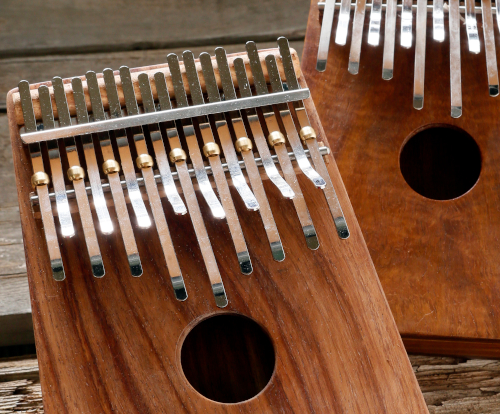
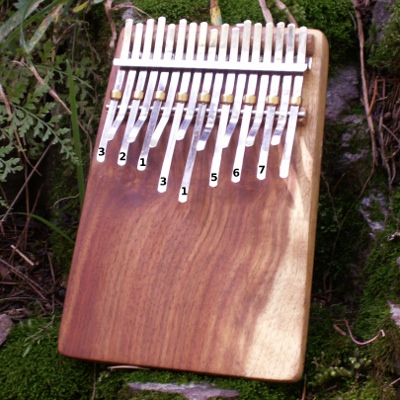 On most kalimbas, the tips of the tines will trace out a simple “V” shape. If the metal properties of the tines are uniform (as modern spring steel is likely to be) you can infer the tuning by looking at the length of the tines. A “V” shape indicates a simple bi-directional tuning such as the Hugh Tracey Alto kalimba. The African-Tuned Karimba shows a very idiosyncratic tuning, with some alternating sections, some scale-like sections, a second row of shorter tines bent upward so you can play them even though they lay between longer, lower tines, and several pairs of duplicate notes. Why is this instrument so odd? The African Karimba co-evolved with centuries of African music – it is designed to play African music, and African music was shaped by this instrument, and it is the forebear of all traditional kalimbas. Modern kalimbas are very different from their antecedents – having been redesigned to play music that is easy for western ears to understand and appreciate.
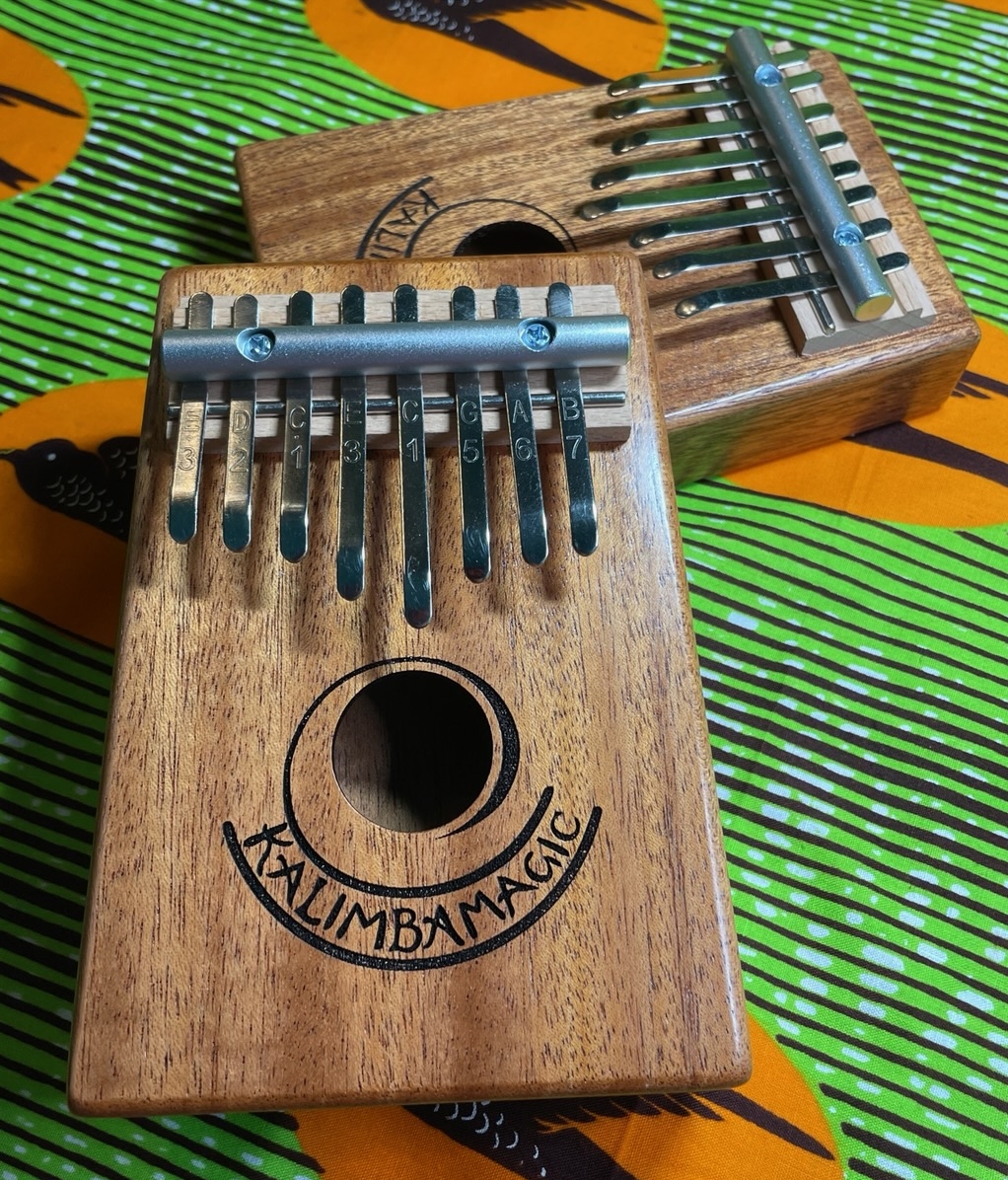
 Andrew Tracey argues convincingly in his 1972 article “The Original African Mbira?” that the first or most basic kalimba is the 8-Note “kalimba core”, which we now sell as the
Student Karimba (front and center in the photo). These eight notes, because they were fundamental to the music, found their way into each subsequent kalimba as the instrument evolved into more complex structures and across cultures. The African-Tuned Karimba (lower left and lower right) is related very simply to the kalimba core: an extra row of shorter, upward pointing tines was added, with each shorter tine tuned either a fifth or an octave higher than its adjacent longer tines. The relationship to the mbira dzavadzimu (top two instruments) is more complex – in addition to an added row of tines, the kalimba core notes are present in mirror image, and one missing note was interspersed, out of order, among the core notes.
 Kalimbas are not particularly loud. They can hold their own when played next to an acoustic guitar, but anything more requires something to boost their sound volume. In Africa, mbira are traditionally played in a gourd, called a deze, which amplifies the sound, adds some buzz and distortion, and shortens the notes’ duration. I made a simple deze by doing the following: I bought a dried gourd about a foot in diameter, soaked it in a tub of water for a day, scrubbed the outside to remove surface debris, cut about 1/3 off the side of the gourd, and drilled two holes to tie a guitar strap onto it. I put the guitar strap around my neck and put the karimba into the gourd, and it makes the sound 3-4 times louder. And I love the warm sound it gives to the instrument.
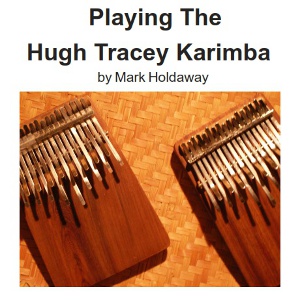 A broad introduction to the layout and the possibilities of this ancient African instrument. With 42 pages, many illustrations, 45 exercises presented in attractive and easy-to-grasp tablature, and a CD illustrating how to play each exercise, this book covers left-right integration, common rhythmic figures, and explores the harmonic potential of the karimba. Wrote the late John R. Raush in the journal Percussive Notes: “Aspiring karimbists… could wish for no better way to help them become proficient on these exotic instruments.”Purchase Book
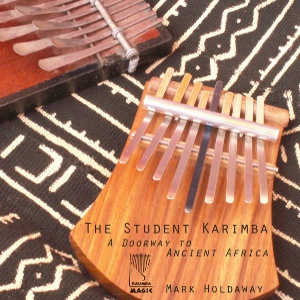 A book for the lower eight (with an optional ninth) notes of the karimba, an instrument which Andrew Tracey calls the “kalimba core” and the “original mbira”. This is one of our best books, and it can be used to learn to play the lower row of notes on the full 17-note karimba or even a rustic mbira nyunga nyunga. Includes traditional tunes documented in the 1950s by Hugh Tracey, in the 1960s by Andrew Tracey, and in the 1970s by Paul F. Berliner, plus some easier pieces to help you get started, along with some complex original compositions by the author.Purchase Book
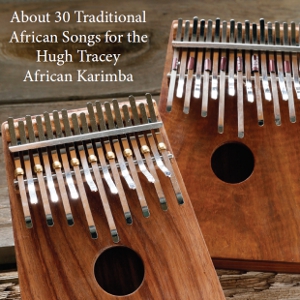 These songs and their multiple variations include music notated by Paul F. Berliner, Andrew Tracey, A.M. Jones, and other songs collected from the kalimba literature by Ivodne Galatea and Mark Holdaway. The definitive collection of Karimba Music – for the 17-Note African-tuned Karimba in A.Purchase Download
These songs and their multiple variations include music notated by Paul F. Berliner, Andrew Tracey, A.M. Jones, and other songs collected from the kalimba literature by Ivodne Galatea and Mark Holdaway. The definitive collection of Karimba Music – for the 17-Note African-tuned Karimba in A.Purchase Book
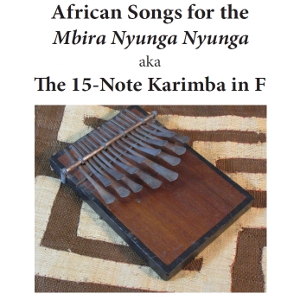 Arranged for the 15-Note Karimba in F, also known as the mbira nyunga nyunga.
This is the same material as the “About 30 Traditional Songs”, but the tablature has been arranged for the slightly different nyunga nyunga. Purchase Download
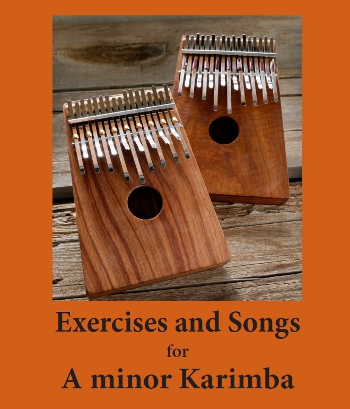 You can learn how to play this mysterious, magical music on your karimba if you tune it down to A minor. Enchanting. Purchase Download
There are several karimba models in the shop, but I just love this image of the Hugh Tracey Alto recast as a nyunga nyunga:
 This is the same tuning and note layout of the karimba Dumisani Maraire brought from Africa in 1968 – he called it the mbira nyunga nyunga. His daughter, Chiwoniso, tuned it up a half step because F# was better for her voice. We can tune this karimba to F, F#, or G. Purchase Kalimba
We offer the African-tuned Karimba in its standard African tuning plus four westernized tunings:
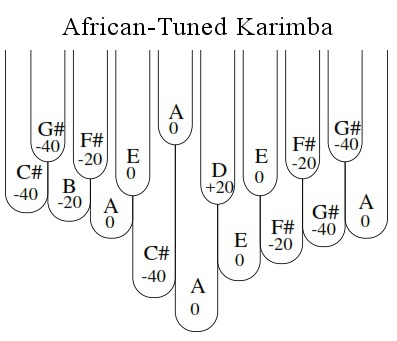
The standard tuning for the traditional, African-tuned karimba is intricate. Use the accompanying chart to tune your instrument. If you have a differently-tuned karimba, you can retune it to the African tuning with this information. And even if you don’t have a karimba, you can learn how a traditional microtonal tuning is set up – it has a logic that is discernable. This is one of the tunings studied by Hugh Tracey as he learned about the detailed tunings of traditional African instruments.
The numbers on the chart are there to help us see, in fine focus, just how sharp or flat the standard tuned notes are. Each number represents how many “cents” sharp (if a positive number) or flat (if negative) that particular tine is, relative to the note name on each tine. A half step is 100 cents. The A’s and E’s are right in tune, while the C# is 40 cents flat, almost halfway between a C and a C#. Why? This is the traditional African tuning that evolved and was perfected in Africa.
The karimba and student karimba books, plus the “10 Traditional Pieces” and “11 Advanced Traditional Pieces” downloads all work with this tuning. They will also work with the A Major or G Major tunings.
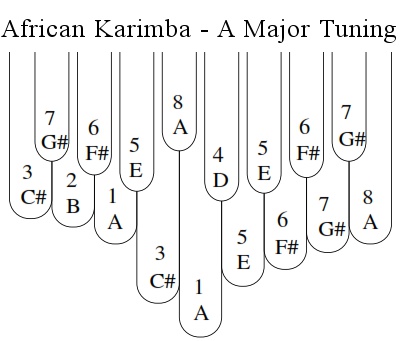
This is the westernized A major tuning for the African Karimba. In this case, the numbers in the diagram refer to the degree of the scale – 1 is the root, 3 is the third, 5 is the fifth, and these notes should all line up perfectly with a properly tuned piano or guitar. Thus you can play this karimba with many western instruments, including guitar and piano. Out of all the westernized karimba tunings, this one is the most useful. Andrew Tracey says that if you put this tuning into the hands of an experienced African player of traditional karimba, they would accept it as more-or-less correct, while they would not accept a minor-tuned version as correct. What this essentially means is that you can play all the traditional songs in this tuning and still get the basic feel of them.
The karimba and student karimba books, plus the “10 Traditional Pieces” and “11 Advanced Traditional Pieces” downloads all work with this tuning.
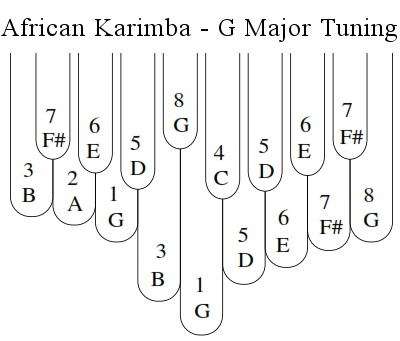
This is the G major westernized tuning of the karimba. This tuning is exactly one whole step down from the A Major tuning. The numbers are all the same, so all the intervals will be the same. Why would you want this instrument in G instead of in A? Because the standard key for Hugh Tracey Alto and Treble kalimbas is G, and if your karimba is also in G then you can play it with the other Hugh Tracey instruments.
The karimba and student karimba books, plus the “10 Traditional Pieces” and “11 Advanced Traditional Pieces” downloads all work with this tuning.
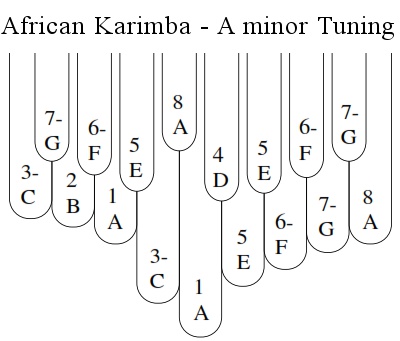
In the accompanying tuning diagram, the minus sign after the 3, 6, and 7 indicate that these intervals are now minor, making it the original African-tuned instrument with its notes rectified down to make an A minor western scale. Why would you want such a tuning? In this tuning, this karimba can produce wonderfully mystical, New Age-sounding music. In addition, it is playable with a Sansula, because A minor is also the standard key for the Sansula. I keep a karimba in this tuning because the A minor tuning has the same notes as the C major scale, and I use it when I perform with my marimba band.
The “Yekermo Sew” and “Three Original Pieces” downloads will work with this tuning.
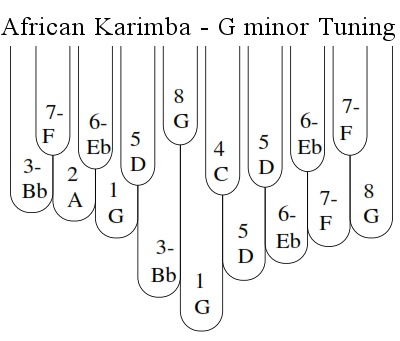
This tuning has the same minor intervals as the A minor tuning, but has been tuned down a whole step.
Why would you want such a tuning? Some people tune their Alto or Pentatonic Kalimbas to G minor because this tuning can lend a more mystical, New Age experience. I use a G minor tuned karimba because it has the same notes as the Bb major scale, so it goes with my Bb Treble.
The “Yekermo Sew” and “Three Original Pieces” downloads will work with this tuning.
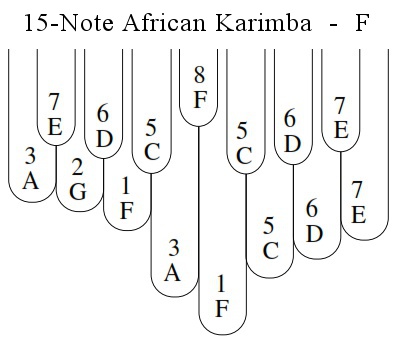 While the 17-Note A-based Karimba is built on a Treble (either celeste or box) platform, it is also possible to build a 15-Note Karimba in F on an Alto platform. F is important and very desirable because of the 55 (minimum) years of history behind the 15-Note F Karimba. In 1960, Andrew Tracey discovered the musician Jega Tapera in the township of Bulawayo, Rhodesia (now the country of Zimbabwe), and he was playing a 13-Note Karimba in F. Jega Tapera was recruited to teach traditional music at the Kwanongoma College of African Music, where students learned on an expanded 15-Note Karimba in F. One of those students was Dumisani Maraire, who brought the 15-Note F Karimba to the USA in 1968, where he popularized it under the name mbira nyunga nyunga (the sparkly, sparkly mbira). Dumisani’s daughter, Chiwoniso, also played the 15-Note F-tuned Karimba.Read more
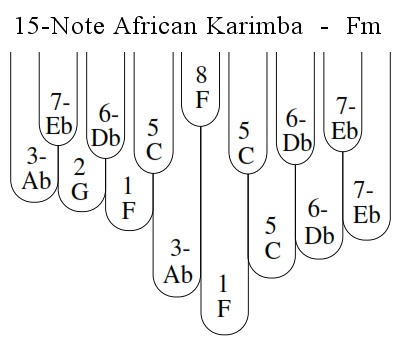 This is the same instrument as the 15-Note F Karimba, but cast into a minor-tuned version.Read more
If you have any questions, feel free to contact us via the email form, or speak directly to Mark Holdaway at 520-488-7641. Contact Us

 Christmas in July 2025
 Patriotic and American Music for Kalimba