






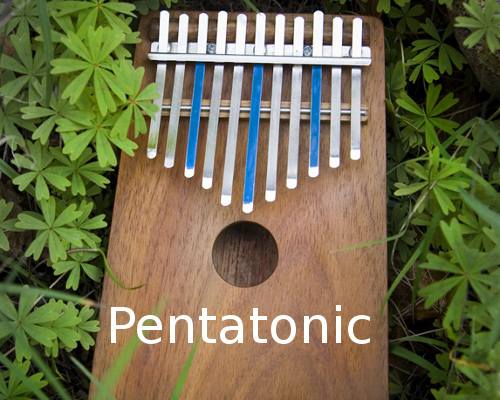
Wild and great fun, the pentatonic scale lets you cut loose and jam with an air of authenticity: the pentatonic scale is used by many indigenous peoples across the globe, and about 40% of the traditional African kalimbas Hugh Tracey studied used the pentatonic scale.
What exactly is the pentatonic scale? Well, there are many pentatonic scales. Basically, any scale with just five notes is a pentatonic scale. Listen here:

The minor pentatonic scale is the exact same “Blues Scale” that every beginning guitarist learns. In fact, it is even in the same key: E minor! So, you can amaze your high school buddies (new or old): while they are doing the twelve bar blues on their guitars, you can whip out your Pentatonic kalimba and solo circles around them. Several of my musically accomplished jamming buddies just LOVE to play the pentatonic kalimba, because they can just totally get into the music making without worrying about that great inhibitor called “critical thought.”
“Malian Blues” is performed on a G minor Pentatonic tuned Box Pentatonic Kalimba.
I think the most important aspect of the pentatonic scale is that the half-step intervals have been removed. Hence, it is not possible to play two notes at the same time that sound really bad. It is sometimes called the “no fault” scale, because people who know literally nothing about music can just go at it as a physical activity (plink-plank-plunk) without fear of messing up — and in doing so can find their own way by listening to the sounds or phrases they are creating, and hanging on to the ones that they like the most..
That means that the pentatonic kalimba is ideal for children. In fact, the Waldorf School uses the pentatonic scale exclusively until their students are about 9 years old. The pentatonic kalimba is also a perfect instrument for meditation, for inner journeying, or for just spacing out to relieve stress.
G major pentatonic tuning.
Can you remember back to the day when your diatonic kalimba still smelled new, and everything you did with it filled you with wonder and amazement? It seemed there was magic in every note or chord you played. Now that you understand a bit more about how the kalimba works, isn’t it a bit like finding out the Wizard of Oz was just the man behind the curtain? And so you might get stuck doing the same things, because now you know what to expect. Remember the days when you had no idea what the kalimba would sound like if you did THIS or THAT, and WOW! 90% of the time it just sounded wonderful nonetheless? Trying to squeeze out the mistakes and make it 99.9% perfect, you can also squeeze out the magic.
Well, you can go back to those magical days without giving up any of the progress you’ve gained on the ALTO or TREBLE or 17-Note Kalimba in C. Just pick up a Pentatonic. The octaves are still on the opposite side of the kalimba (because 5 and 7 are both odd numbers). But if you try to play anything with your tried-and-true thumb-picking patterns, what you will get is an intersection between the internal logic of the Pentatonic kalimba and your own internal patterns, creating something new. And the coolest part? That sense of newness and magic can be translated back to your other kalimbas.
An exotic oriental Ake Bono pentatonic scale.
Francis Bebey Tuning, an F7 pentatonic scale.
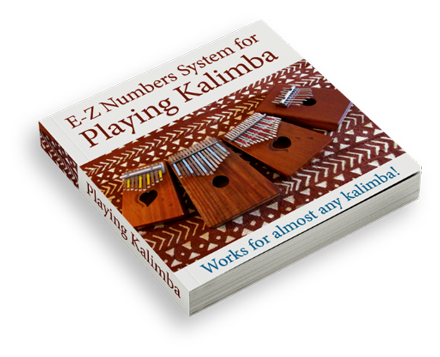
There is a fair amount of instructional material for the Pentatonic Kalimba, but the best thing you can do on the instrument is to improvise. The book “Playing the Pentatonic Kalimba” shows you a lot of ideas that will help you in your improvisations – I have called it the “Patterns” book. The other two books are more song-based.
Free Tablature! Alto and Pentatonic Kalimba Kushaura and Kutsinhira
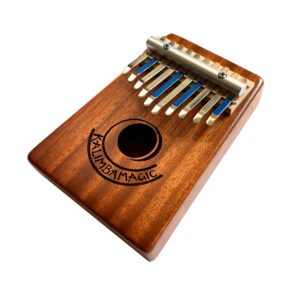
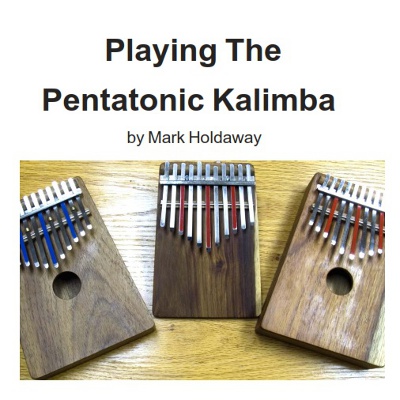
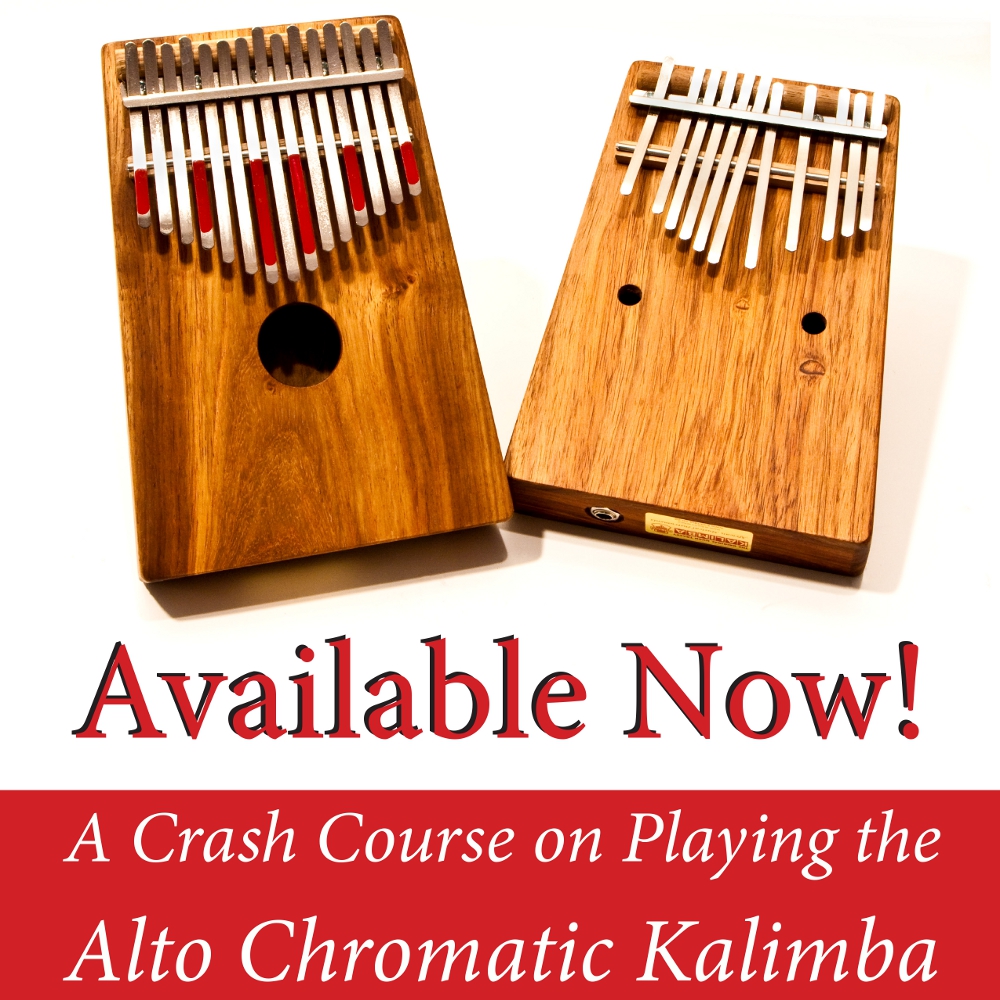
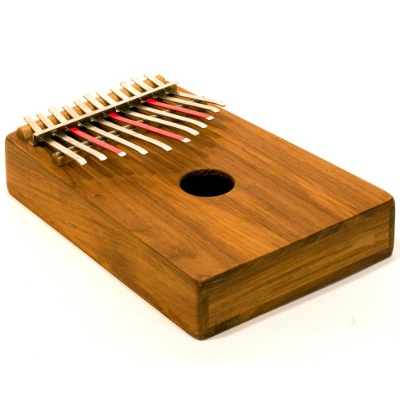 The Box Pentatonic Kalimbas have the same body as the Alto Kalimba, and the same range – exactly two octaves from G to G.
However, instead of covering two octaves in 15 notes, the Pentatonic covers it in 11 notes. The gaps in this scale make it more forgiving, more primitive, in some ways more powerful. Great fun. Purchase Kalimba
Pentatonic Kalimba with electronic pickup. Purchase Kalimba
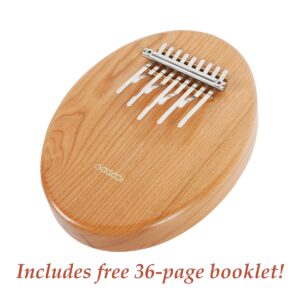
 The same notes – and the same tuning possibilities – as the Hugh Tracey Box Pentatonic Kalimba, but mounted on a celeste body. This fits more comfortably in smaller hands, and can also be put into a gourd for traditional amplification. Purchase Kalimba
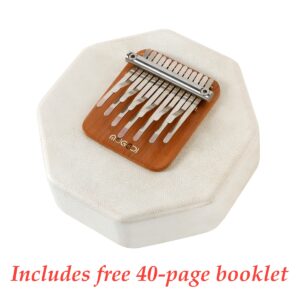
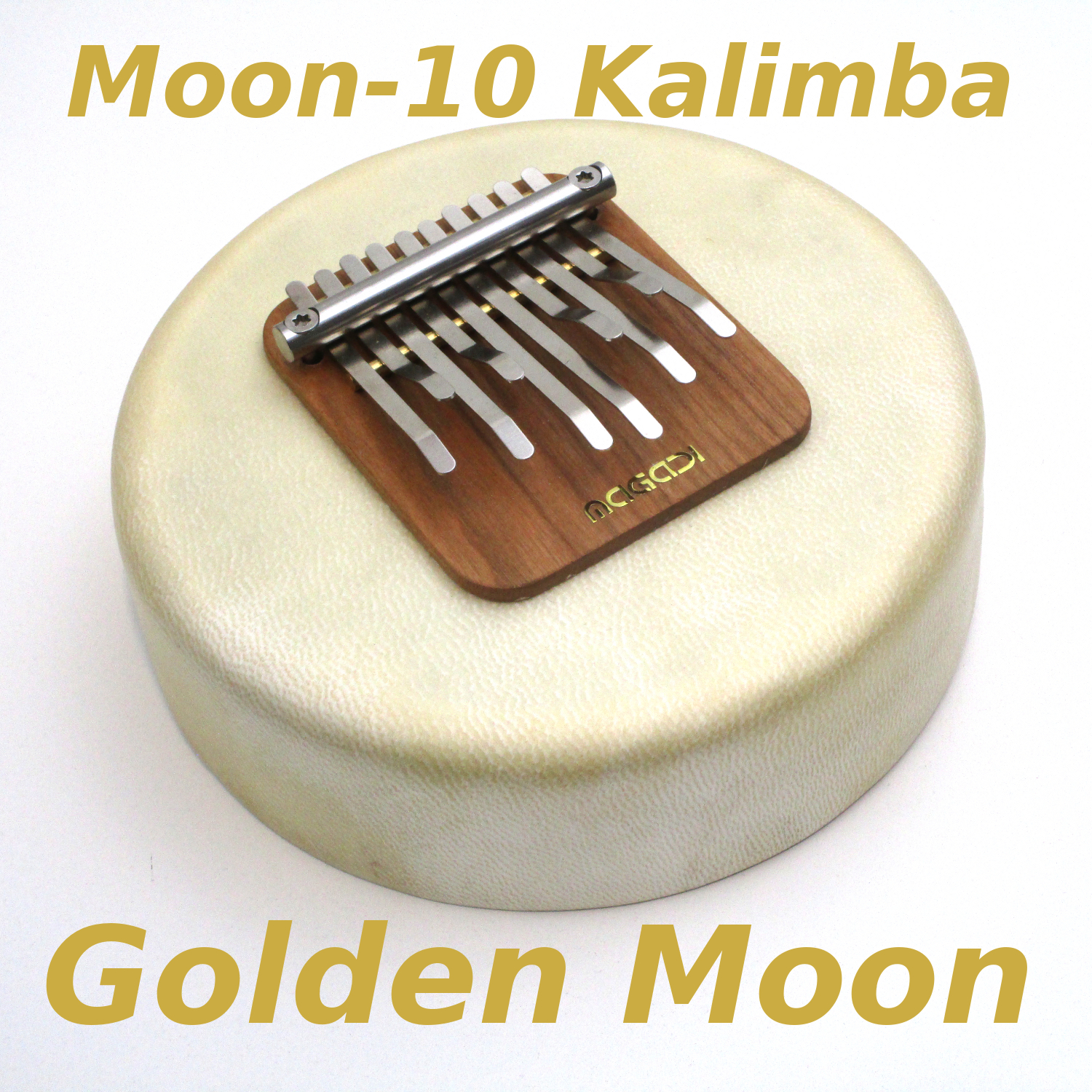
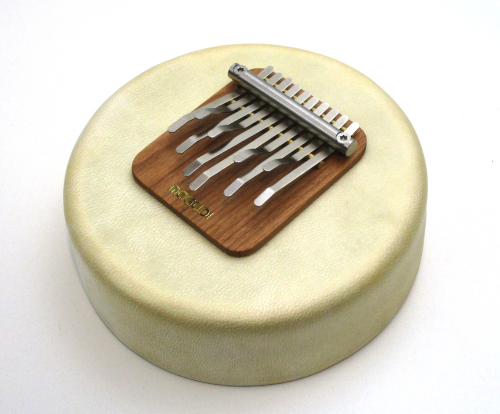 The Magadi Moon-10 is a great new kalimba that comes in a standard C major pentatonic tuning. There are several other pentatonic tunings: Blue Moon Tuning is C minor pentatonic, Silk Moon is A minor Ake Bono pentatonic. This kalimba is a great Sansula alternative. Purchase Kalimba
The pentatonic scale is a five tone scale (five notes per octave). There are actually many different pentatonic scales, each with different character, and some of them can be found here.
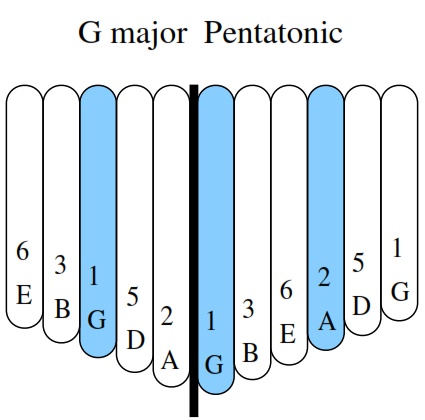
The letters on the tines are the names of the note each tine is tuned to. As G is the root, its role in the music is as the “1”; D is the “5” of the scale. Note that the 4th and 7th are missing. With a little practice, you should be able to see the “1 2 3” and sing “Do Re Mi”… but this tuning skips “Fa” and jumps straight to “So”. By paying attention to the numbers, you can understand how the scale goes and how to use it musically.
The standard tuning of the Hugh Tracey Pentatonic Kalimba is G major.
The Pentatonic Songbook, half of the book
Playing the Pentatonic Kalimba,
and the full numbers-based book 6-Note Pentatonic Kalimba Songbook all will work for this tuning.
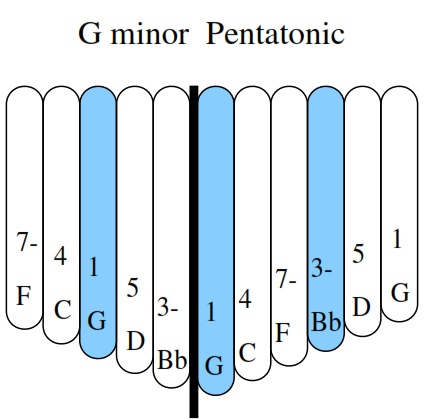
One of the easier and more obvious alternative tunings for your Pentatonic Kalimba, the minor pentatonic scale has recently become popular because of the Native American Flute. It’s a great scale to jam on and you can have plenty of fun without any instructional material, but if you want some guidance, the second half of the book
Playing the Pentatonic Kalimba works for this tuning. This kalimba will work with the Bb Treble Kalimba or any G minor tunings.
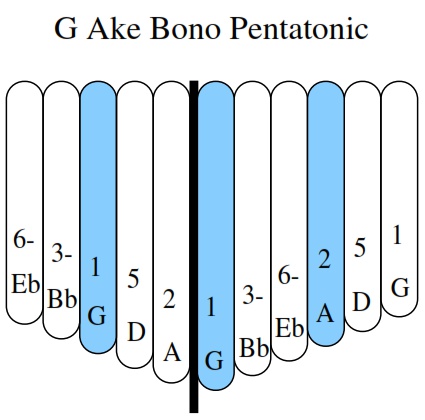 The Ake Bono scale is a Japanese minor pentatonic scale. The song “Sakura” is written in this tuning. The interesting thing that makes this tuning different from the other pentatonic scales that we have discussed is that this scale has two half step intervals (from 2 to 3- and from 5 to 6-) and two intervals that are each two whole steps (3- to 5 and 6- to 1). It is very closely related to the standard G major pentatonic scale – you just tune the B and E down to Bb and Eb. This is a very mystical and beautiful scale. Listen to This Kalimba Tuning
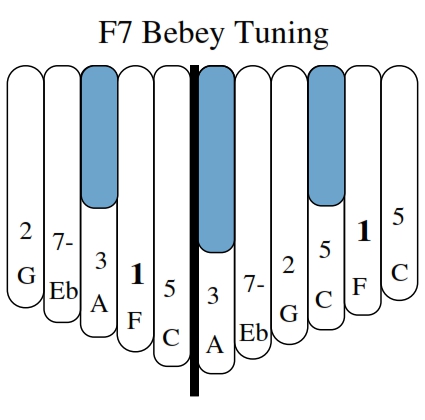
This tuning is found on Cameroonian music legend Francis Bebey’s song “Breaths”. I don’t know anything more about it other than that.
Francis Bebey tended to use a different kalimba tuning for each of his songs. He would lay down a flourish of kalimba notes in an introductory solo, followed by a groove established by the kalimba. The rest of the band – drums, bass, guitar – would then come in on top of the kalimba groove. The kalimba groove would stay constant for the rest of the song.
The musical example of this kalimba uses more of a “solo kalimba” approach throughout the piece.
Listen to The F7 Bebey Pentatonic Kalimba Tuning:
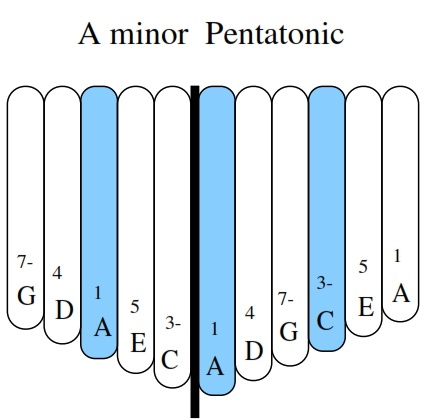 The A minor pentatonic scale has the same degrees of the scale (that is, the numbers) as the G minor pentatonic scale, but it is shifted up a whole note in pitch. As such, it will still work with the second half of the book
Playing the Pentatonic Kalimba. This kalimba will work with other kalimbas in G major tuning, other kalimbas in A minor tuning (such as Maurice White’s Evil Tuning on a Treble or Alto), and the standard A minor Sansula tuning.
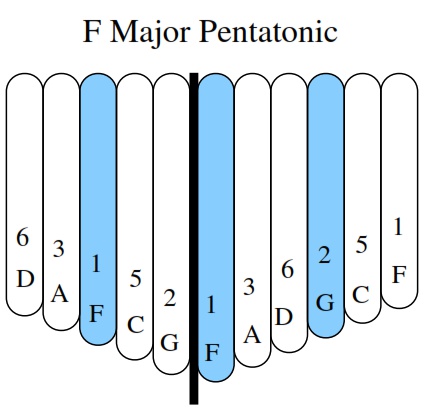 This F Major Pentatonic tuning is just like the standard G Major, but every note has been shifted down by a whole step. All of the relationships between the tines remain the same when retuned in this way. We can actually retune to F, F#, G#, A, or Bb in this manner.
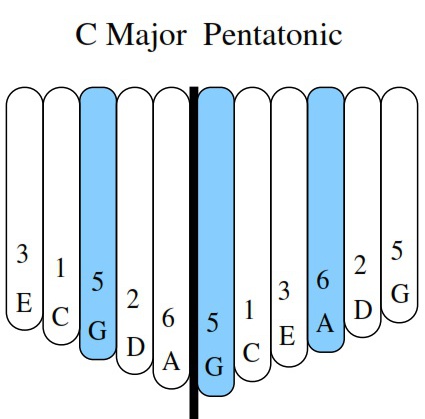 This is very close to the standard G Major Pentatonic tuning – the two B tines have been pushed in a half step to make C, which becomes the root note. Having the 5th in the bass is always a good alternative to having the root note in the bass. This tuning will work with the
numbers-based book 6-Note Pentatonic Kalimba Songbook. Of course, this tuning will work well with any of the Catania kalimbas in their standard C tunings, or with any instrument in A minor (such as the Sansula in standard tuning).
If you have any questions, feel free to contact us via the email form, or speak directly to Mark Holdaway at 520-488-7641. Contact Us