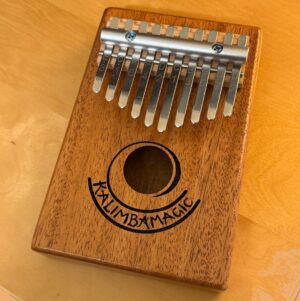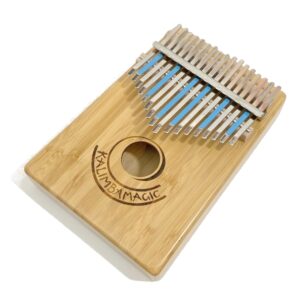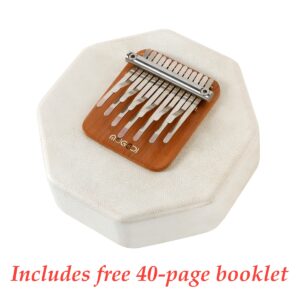
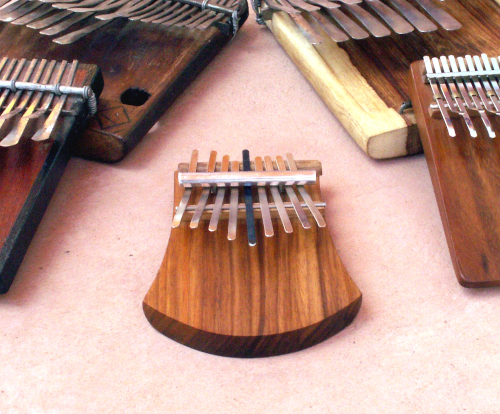
The 9-note student karimba – called “the original mbira” by Hugh Tracey – is related to the first metal tined kalimbas from the Zambezi Valley over 1000 years ago. A great place to start, this karimba’s design has a rich centuries-old African tradition.
This Goshen Box Student Karimba uses digital delay to simulate the kutsinhira and kushaura parts.
Andrew Tracey, Hugh Tracey’s son, hypothesizes that this basic instrument is the “kalimba core”. A.M. Jones described it in his 1950 scholarly article on “The Kalimba Music of the Lala Tribe of Northern Rhodesia”, referring to it as the kankobella. And there is reason to believe that when Portugese Father Dos Santos first appeared on the scene in 1586, that this tuning is basically similar to the 8-Note instrument he described. Making him perhaps the first European to write about the kalimba.
And why would you want to play a Student Karimba? I play this instrument because when I do, I can see the sonic universe of ancient African humans – I can recreate the sorts of songs that they could have played 1000 years ago. And I can be amazed at the music that came from this instrument. That is, by playing this instrument, I can share something of what the ancient African mind was like. This gives me feelings of both great pride in belonging to the race that created this, and of great respect for the ancient African mind.
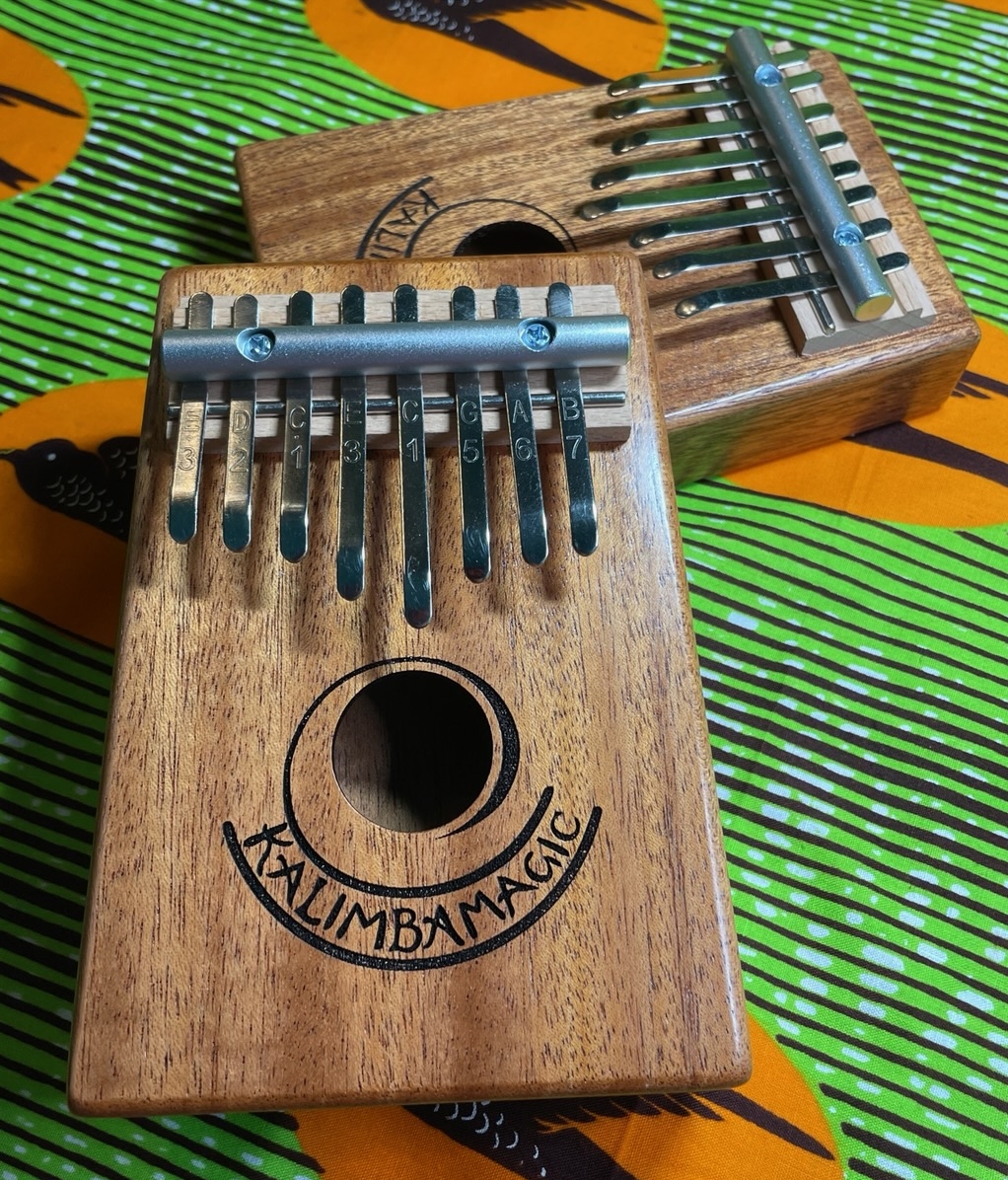

On the left: an instrument that a friend acquired in Africa circa 1950, judged by Christian Carver to be “not a tourist instrument, but a real player’s instrument.” Only four tines remain, but there were initially eight tines total. The shape is a traditional one, which Hugh Tracey had encountered in the field during his research. The hole in the center was originally covered by a dense spider web which produced a warm buzzing sound. We cannot tell what tuning this instrument was originally in, but I would guess that it was in the same tuning as the Student Karimba.
On the right is the Hugh Tracey 9-Note Student Karimba, a modern copy of what could be the original tuning which gave rise to all other metal-tined mbiras and kalimbas in southeastern Africa.
Andrew Tracey was the first to recognize the importance of this little 8-note kalimba in the evolution of mbiras in southern Africa. (Read a great interview with Andrew Tracey by clicking the link below.) Kalimba Magic commissioned the manufacture of the Student Karimba, and now markets this instrument and creates and sells instructional materials for it.
 The shield shape of this instrument inspired Hugh Tracey, and he used it on his “Kalimba Logo” – a stylized 9-note kalimba, which was apparently first conceived of by Tracey in the 1930s. This graphic is taken from the 1968 instructional manual Hugh Tracey put out with the Treble and Alto kalimbas, but it can be found on the box of every Hugh Tracey kalimba sold by African Musical Instruments (AMI), Hugh Tracey’s company. AMI never actually made a 9-note instrument like the one on their logo – until Kalimba Magic asked for it.
 Here is an illustration of the 9-note instrument atop a dried gourd that was used as a resonator. The karimba and the gourd are not attached and the karimba must be held in place by the player’s downward pressure. This also meant that the player could lift it off the gourd and lower it back again to make a “wah wah” sound – a sound similar to the 1960s electronic “wah wah” effect. Kind of mind-blowing that it was quite possibly being made by some very cool people in Africa around 1000 years ago.
 Gerhard Kubik, in his book Kalimba, Nsansi, Mbira – Lamellophone in Afrika (1998, Museum fur Volkerkunde), recognizes the centrality of this instrument. You can tell the approximate tuning of the karimba in this photograph by looking at the lengths of the tines – the two low notes in the center, followed by three notes in a scale on the right side, then three notes in a scale on the left side. This kalimba was tethered to a gourd, but it was up to the player to put the karimba on the gourd. The size of the hole on the gourd’s mouth has been modified by a piece of wood, making the mouth smaller. The gourd serves as a “Helmholtz resonator” (Helmholtz resonance is the phenomenon of air resonance in a cavity), and the smaller mouth lowers the resonant frequency of the gourd. In other words, the makers of this instrument modified it so that certain particular notes on the karimba were most strongly affected by the “wah wah” effect. They “tuned” their Helmholtz resonator. Very cool!
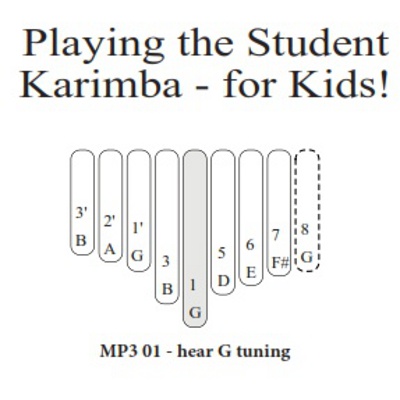
 Go back and look at the lengths of the tines in the photo on the previous page. The diagram on the present page has the same shape, and illustrates the tuning of what Andrew Tracey described as the “kalimba core” in his 1972 paper “The Original African Mbira?” The numbers 1, 3, 5, which make a major triad, are the same degrees of the major scale that I use in my modern tuning charts. On the right, 5, 6, and 7 are the upper segment of the scale, and on the left 1′, 2′, and 3′ are the first three notes of the scale or “Do Re Mi”, but they are an octave higher than the low notes 1 and 3.Read Andrew Tracey Interview
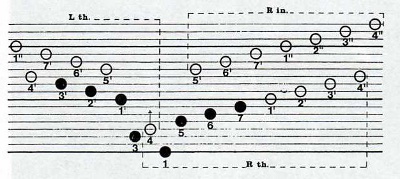 Andrew Tracey demonstrated that these eight notes were always found at the center of more complex instruments. Notes are often added in a scale-like manner to both sides, or extra notes (or series of them) can be added as additional rows of shorter (higher) or longer (lower) notes, above or below the original row.
 The mbira dzavadzimu is one of the pinnacles of African music. The kalimba core can be seen at its center, but it is seen in mirror image, a “4” is positioned, out of order, among its tines, and an extra row of lower notes is added, in addition to the extra tines to the right and the left.Read Andrew Tracey Interview

Most traditional African thumb pianos are falling away and in many cases, the last people who knew how to play them and the traditional music that co-evolved with them are gone. The mbira dzavadzimu, on the other hand, has become popular world-wide and now many more people play it than at any time in its history.
The notes of the Kalimba Core and the music that they play can be seen as a fossil from the history of the entire mbira family; this fossil is the seed of all of traditional African lamellophones as well as the music that is played on them. The fate of most of the original thumb pianos will not befall the 8- or 9- note Kalimba Core, which lives on today as the Student Karimba. Almost every traditional thumb piano song that Hugh Tracey recorded on his expeditions, almost every traditional karimba song, and many mbira songs have variations that use these notes, so there is a substantial repertoire of music that can be played on the Student Karimba.
I have long felt it has been my calling to show the people of the world how to make music with all kalimbas, but it brings me special joy to educate about this particular one. This instrument has a special place in the history of African music, and I have played a special role in making that history known through direct musical experience rather than just through intellectual ideas.

Here is a strange riddle: Consider the 8- or 9-note instrument that I call the Student Karimba, or what A.M. Jones called the Kankobela, in 1950, or what Andrew Tracey call both the Kalimba Core and the Original Mbira in 1972. This instrument did not exist on the market until Kalimba Magic wrote a book full of both modern and traditional African music that this instrument plays. Then we commissioned Goshen and AMI to create instruments that would play this music – that is, modern reproductions of The Original Mbira. As far as I know, we are the only people on earth who sell these instruments.
The Heart-10 Kalimba can be reformed into a 9-Note Student Karimba in C. Student Karimba can be tuned to either G or to A. It is a perfect lead-in to the full 17-Note African Student Karimba, whose lower row is exactly the same as this instrument. Purchase Kalimba
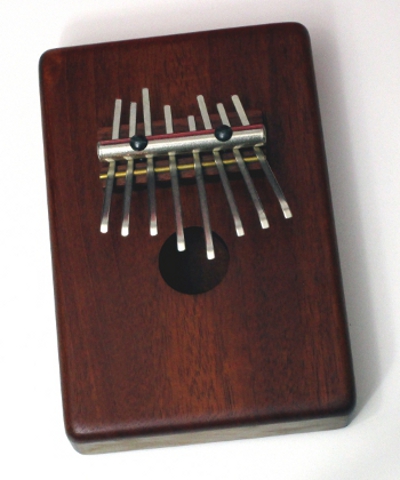
This instrument is a modification of the Goshen 8-Note Box Kalimba. You can see from the tine lengths that this kalimba has been retuned to be an 8-Note African Karimba. This box seems to sing better when the instrument is tuned to a low note of C, and I don’t recommend G tuning. I really love this one. Purchase Kalimba
A large part of the purpose of the alternative tunings to other kalimbas is to step out into the world of different possibilities – different sonic universes that can amaze and delight. However, the student karimba is all about being true to this possibly ancient tuning. The different tunings we present for the Student Karimba are all the same basic tuning, but shifted into different keys – there are general reasons to put the student karimba in any of C, F, A, and G, but each of these Student Karimba tunings will be able to play the exact same songs because the relative tuning between the different tines will be the same in all of these tunings.

The big Student Karimba Book has recordings in G, while the Student Karimba for Kids has recordings in both G and C. The far right note, 8 = G, is an optional note and is the exact same note as the G tine third from the left.

The big Student Karimba Book has recordings in G, while the Student Karimba for Kids has recordings in both G and C. The far right note, 8 = C, is an optional note and is the exact same note as the C tine third from the left.

Hugh Tracey demonstrated that traditional African tunings did not use the same system of notes that western music was based on – that is, African music doesn’t exactly fit onto the notes of the piano. This tuning diagram represents the notes in terms of the degree of the scale (1, 3, 5) and the cents flat that each note should be tuned to. The 0 underneath the 1, 5, and 8 mean these notes should tuned exactly in tune to western notes, while the -20 and -40 indicate that these notes should be tuned 20 or 40 cents flat. There are 100 cents in a half step (that is, the distance between two adjacent notes on a piano).
We usually tune the Student Karimba to be right on the western notes, but you can request an African tuning (in A, G, C, or F), or you can do it yourself.

Why would you want a Student Karimba tuned to A? So that you can play it with the 17-Note full African Karimba, which usually comes in the key of A.

Why would you want a Student Karimba tuned to F? So that you can play it with the 15-Note Karimba in F.
If you have any questions, feel free to contact us via the email form for call us. Contact Us

 Christmas in July 2025
 Patriotic and American Music for Kalimba