






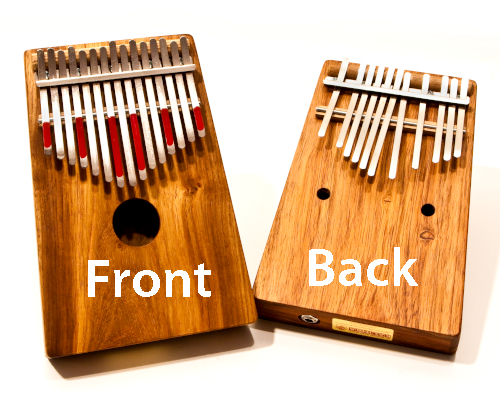
Do you want a real challenge? Do you want a kalimba that will allow you to play essentially any sort of melody or harmony? Then the Chromatic Kalimba is your instrument. The Chromatic has the “white notes” on the front and the “black notes” on the back.
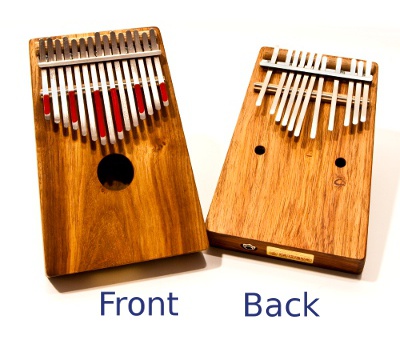 One major issue with most kalimbas is that they are tuned to the diatonic scale (“Do Re Mi Fa So La Ti Do”) and so they are missing the chromatic notes, which are the sharps and flats, or accidentals (the note between “Do” and “Re” for instance). The simplified diatonic scale helps make the kalimba an easier instrument to learn, but makes it difficult or impossible to play complex songs with key changes or notes beyond the diatonic scale. Scott Joplin’s The Entertainer, for instance:
“The Entertiner” requires the chromatic notes. When you hear a note but don’t see a thumb stroke, that is a back side chromatic notes.
You will see other ways to lay out the notes on a chromatic kalimba, and while the Hugh Tracey Chromatic Kalimba has its challenges, I personally am captivated by this design, and people all over the world are becoming good at this instrument. It is true to the kalimba concept – the way of holding your mind and body such that right and left thumbs bounce off of each other to synthesize a unique sort of music.
The Chromatic Kalimba looks just like the Hugh Tracey Alto kalimba on the front… but the notes that are usually missing from the Alto Kalimba (F, Bb, Eb, Ab, and Db) are present on the back. It is challenging to play the notes on the back side with your fingers when you cannot see them, but after many hours of serious work with the instrument, you will have every note over a two octave range at your fingertips.
Look in the mirror: you can see me play the chromatic notes with my fingers!
The front side of the Chromatic is just like the diatonic Alto Kalimba, and this means that you can use any of the
Alto books for instruction on playing these 15 of 26 total notes.
With the “flats on the back” played by your fingers, you cannot actually see them. Where are they? I place black dots on the front side tines that have their flats immediately behind them. Front side tines G and C don’t have dots on them:, their flats are F# and B, which are located on the front side. Hence, G and C have gaps behind them. The lack of dots on these tines reminds me not to look for their flats behind them, but find them on the front of the kalimba, played by the opposite hand to the original unflatted note.
Here are a few simple adjustments that can be made to the chromatic kalimbas to make them much more playable.
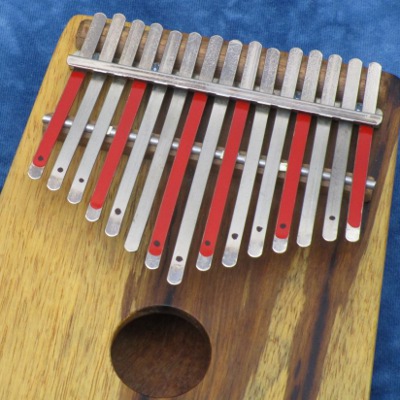
Some of the tines on the front do not have flats on the back, but most do. I use a Sharpie marker to make a little dot on the front-side tines that do have flats immediately behind them on the back side. Pictured is my personal Chromatic Kalimba, complete with dots indicating the flats. We put the dots on every Chromatic Kalimba we send out.
 Looking at these Celeste Chromatics, you can see the correspondence of the front-side tines without dots and the gaps in the back-side chromatic tines. As the dots are made with a Sharpie marker, you can remove them with alcohol wipes. When the dots wear off from playing, you can just get your own Sharpie marker and put them back on. If you are uncertain which tines to put the dots on, you can either figure it out from the back side tines directly, or you could look at the chromatic tuning diagram.
In this photo, the tines on the front of the Chromatic Kalimba are all parallel, but the tines on the back side are splayed apart. Why? The flat notes on the back are “right below” their unflatted counterparts on the front, and if you have really big hands, you might look at A on the front, imagine where the A flat is on the back right behind the front A, and nail it. When I used to try that, I always missed… that is, until I scooted the back left tines a few mm further to the left, and the back right tines a few mm further to the right. I have moved the back-side tines outward until they feel just right, and then when I guess where they are I find I get them almost every time.
We don’t move the back-side tines apart when we send the Chromatic Kalimbas out, just in case you have big hands or you don’t want them that way. You are encouraged to play around with the kalimba and shift the tines until they feel good to you. By the way, when you slide those tines over, you will probably excite a buzz or two, but you have all the tools you need to fix those buzzes.
There is a growing body of music written for the Chromatic kalimba that is available for free from the Kalimba Magic website. These are provided in chromatic tablature, which shows the front-side tines in the center, and the back-side tines as shaded tines on the far left and right. This is not so easy to read, but try this: print out the tablature, and every instance where a back side note is required – say an Eb – you could make another mark on the E tine, which reminds you to play the Eb right behind the E.
Carol of the Bells needs a Chromatic to really be done right. Alto and Treble versions are available at the top of the linked page, but scroll down to see a version specifically for the Chromatic kalimba.
A book for the Chromatic Kalimba is something that has eluded me for some time. You are free to download this poorly configured draft book for the Chromatic Kalimba. It has some useful insights into how to play this instrument, and some music that gently adds the chromatic notes. Another useful thing you can do is to get an
Alto book to instruct you on playing the front side of the Chromatic Kalimba.
The Hugh Tracey Box Chromatic Kalimba is our best selling chromatic, and it is the one that I own personally. The box is the same size as the Alto kalimba’s box. If you have small hands or short fingers, this one will be difficult to reach around to play the chromatic notes on the back.
By the way, every Chromatic Kalimba we sell comes with an electronic pickup.
Our thinking is that these instruments are all going to pretty serious players, so we are doing them the favor of sending them instruments already supplied with the capability of being amplified at a performance.
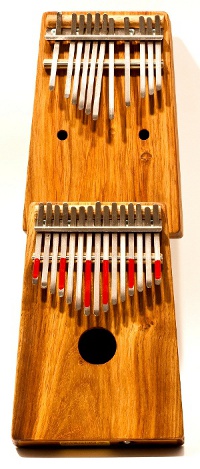
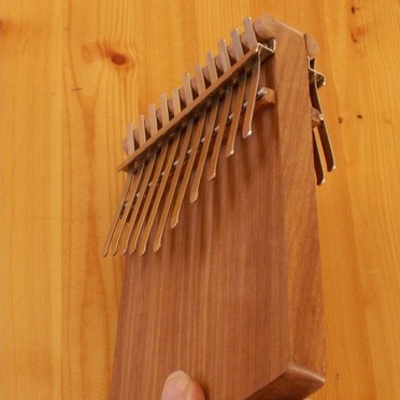 The Hugh Tracey Celeste (board-mounted) Chromatic Kalimba has the same hardware as the box chromatic, but it is mounted on a smaller, narrower board. This smaller body is easier for people with small hands or fingers to hold and play. Automatically comes with pickup. The disadvantages: it is not as loud as the box chromatic (when unamplified), and you can’t do the “Wah Wah” effect.Purchase Kalimba
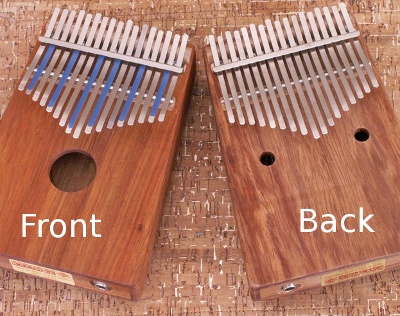
The Hugh Tracey Treble (box) Chromatic Kalimba is mounted on a treble kalimba box, and has 17 notes on the front in the key of C (with C in the bass note). The Treble Chromatic has different notes than the Alto and is tuned a fourth higher, but the tines are painted just like the Alto tines. The front is just like a 17-Note Kalimba in C.
The back side has the “flats”, each right behind the unflattened notes. The “redundant” setup has 17 tines on the back (that is, B will be opposite C on the front, but also on the back just behind C; ditto for E relative to F). The “non-redundant” setup has gaps on the back where B and E would have been found, as they are on the front… and hence only 13 tines on the back.
 We are adding this model to our inventory for the first time in June 2020. It is 17 notes of the Treble Kalimba in C on the front side and the flats on the back – either 17 (redundant) or 13 (nonredundant, missing the E and B on the back) notes. This model will always come with an electronic pickup.Purchase Kalimba
Click on the tuning name to see the tuning and read about it. There are two different tuning setups available for both the Box Alto Chromatic and the Celeste Alto Chromatic Kalimbas: G or C. The Treble Chromatic Kalimba has two different setups: both in C, with or without redundant notes on the back.
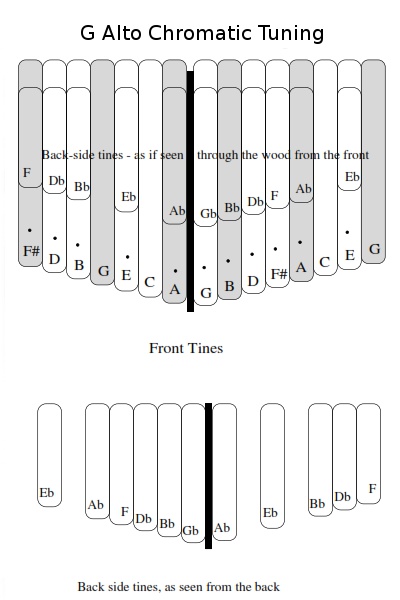
On these chromatic tuning charts, the front tines are the long ones in the top diagram; six are painted (shaded gray). The back-side chromatic tines are represented twice – first, higher up on the upper diagram
the back side tines are displayed as if you could see right through your kalimba . In this view, wherever there is a back-side tine, there is also a dot on the corresponding front tine. The back-side tine is always the flat of the corresponding front-side tine. When you flip the kalimba over and look at the back-side, you will see the mirror image of the previous representation. These are the unpainted tines shown in the lower diagram.
Kalimba Magic recommends that your Chromatic Kalimba be tuned to G on the front, making it just like the Alto kalimba. This means that if you know how to play songs on the Alto Kalimba, you can play all of those songs on the Chromatic’s front, and you can add the chromatic notes on the back at your own pace. It also means that all of the books and educational resources for the Alto kalimba will work for the front side of your Chromatic Kalimba. Plus, since the forthcoming Chromatic Kalimba book will be written for the G Chromatic Kalimba, you will be able to use it.
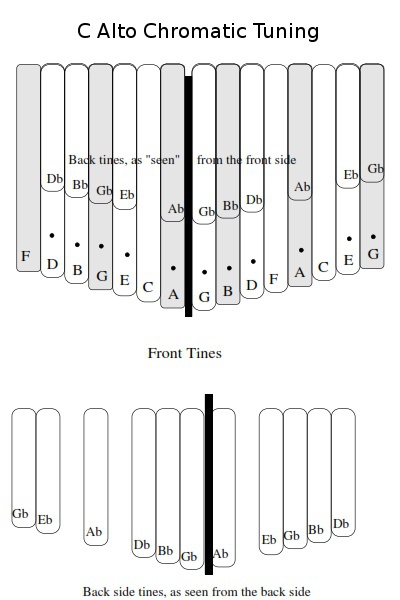
It is possible to retune from G to C (or from C to G). The Chromatic Kalimba in either G or C setup will have all of the chromatic notes over the same two octave range, but some people prefer the C tuning which makes all the front notes be “natural” notes, and all the back-side notes be “flat notes”. (If the Chromatic Kalimba is retuned to C, the front notes are the same as the C-Alto, for which there is an instructional download.)
Retuning from G to C on the front is trivial, only requiring tuning F# to F natural. On the back, most of the tines need to be both rearranged and retuned – the tines need to be taken off the kalimba and reinserted through different slots, as the gaps on the back are positioned in different places in the two tunings. This is difficult but not impossible. If you know from the start that you want your Chromatic Kalimba to be tuned to C on the front, you should order the instrument in the C tuning.
If you already have the Chromatic Kalimba, the
Kalimba
Doctor can take care of retuning for you ($20 covers tuning and domestic US return shipping).
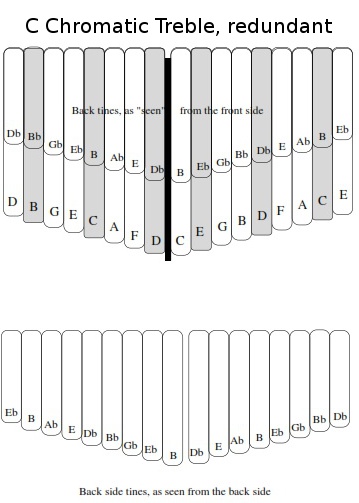
The Chromatic Treble Kalimba has a bass note of C, and the front side is laid out like the Bb Treble, tuned up to C. In its standard tuning, every tine on the front has a flat immediately behind it. That is, there are 17 tines on the front and 17 tines on the back. However, as C flat = B and F flat = E, which are already on the front side, this kalimba has redundant B notes and redundant E notes, one on the front and one on the back. This permits you to trill those notes – playing quickly on the front side and then the back side, etc.
Another way to think of the back side is that it is a full kalimba tuned to B natural… but if you look at it from the back side the notes are reversed left to right. If you could look right through the kalimba, the notes would be oriented the usual way.

The C Chromatic Treble Kalimba can also be arranged in a non-redundant setup. The gaps between the tines on the back-side really help me find my way on the Chromatic Kalimba, just as the black notes and the gaps between them similarly help a pianist on the keyboard. For this reason, I prefer removing the redundant tines from the back-side of the Chromatic Treble Kalimba, but either setup is available.
Learn to Play the Elvis Presley hit “Love Me Tender” on Kalimba
If you have any questions, feel free to contact us via the email form, or speak directly to Mark Holdaway at 520-488-7641.Contact Us